
HENRY M. JACKSON WILDERNESS, WA :: I have been waiting to return to Goat Lake for a long time. Although it had been more than six years since I first hiked this trail, the picturesque image of snow-laden Cadet Peak reflecting off Goat Lake has never faded from my mind. The Mountain Loop Scenic Highway was closed in 2003 just North of Barlow Pass. A major rock slide shifted a section of the road into the Stillaguamish River, blocking access to the trailhead. Four years and $10 million later, the road has been rebuilt and reopened.
Ice and snow covered much of the road beyond Barlow Pass, and it was 26 degrees at the trailhead at 8:30 AM. I started my hike shivering and bundled under several layers, hats and gloves, but after about twenty minutes, I was comfortable in just a t-shirt. The trail had a light dusting of fresh snow, and it was easy going for most of the way. I started on the Upper Trail and took the connection to the Lower Trail at the 0.8 mile mark. There were just a couple blowdowns which were easy to get around. The trail was in surprisingly remarkable shape, despite being mostly unbothered for four years and the recent storms.
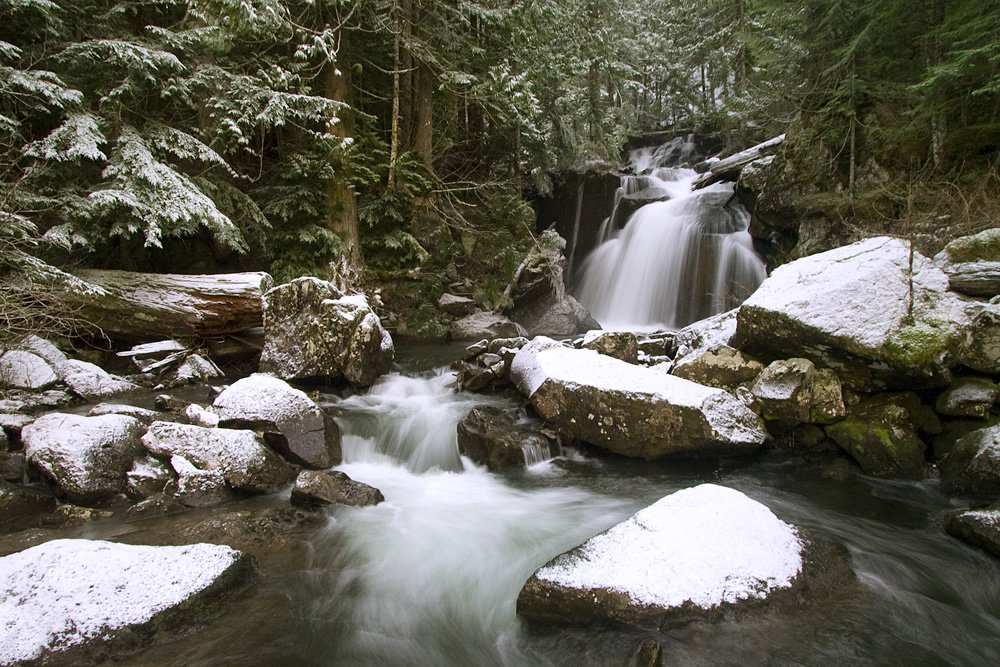
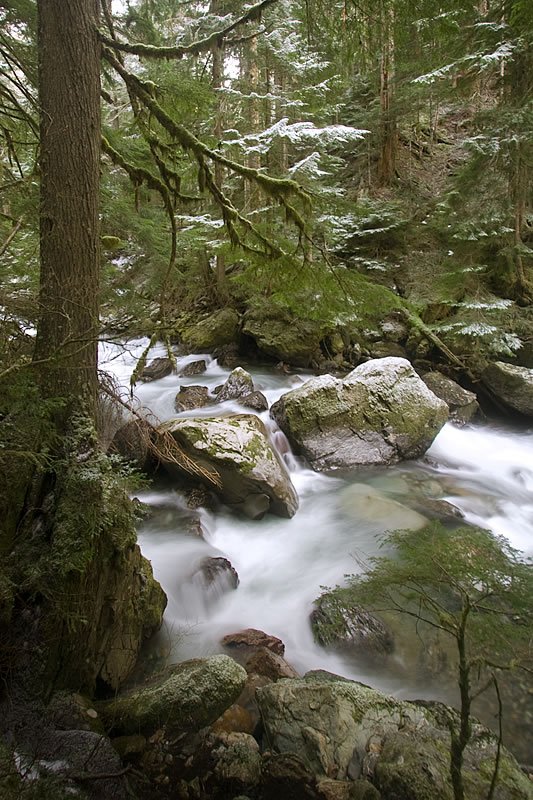
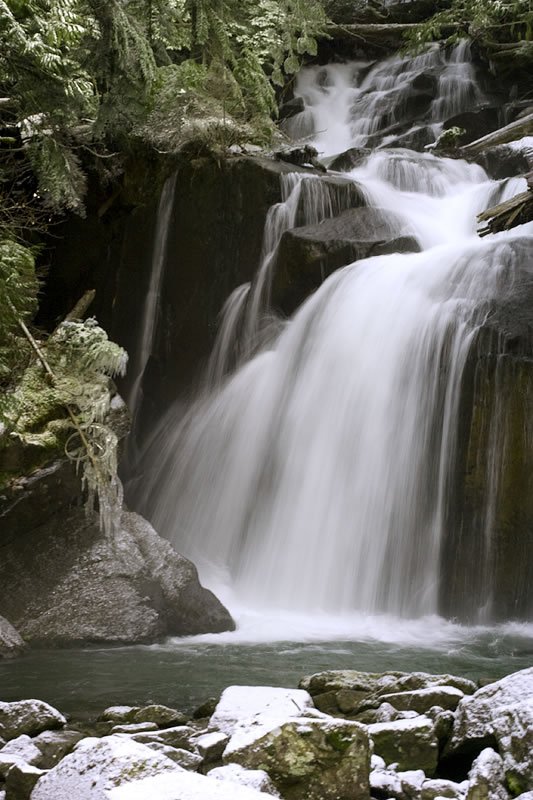
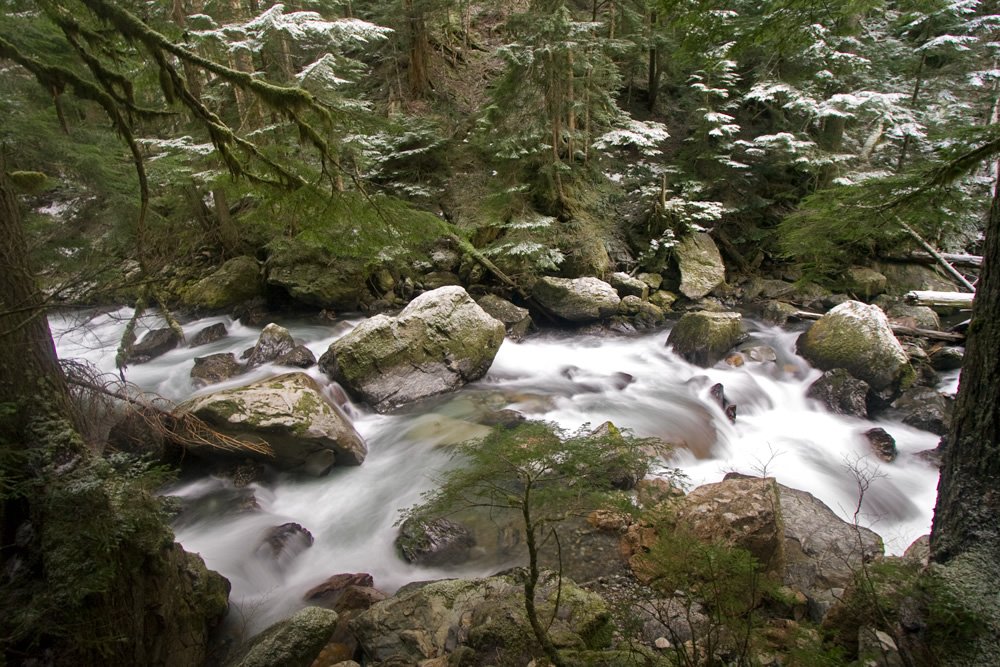
The trail became hard to follow just before the lake. As I did on my first hike six years ago, I got lost and needed to scramble alongside the falls to find the lake. On my way back, I found where I took a wrong turn. But if I had stayed on the trail, I would have missed an impressive set of waterfalls. There are several US Forest Service signs marking some type of boundary in this area, but they were turned in every direction and really unclear about indicating the area I was not supposed to be in.
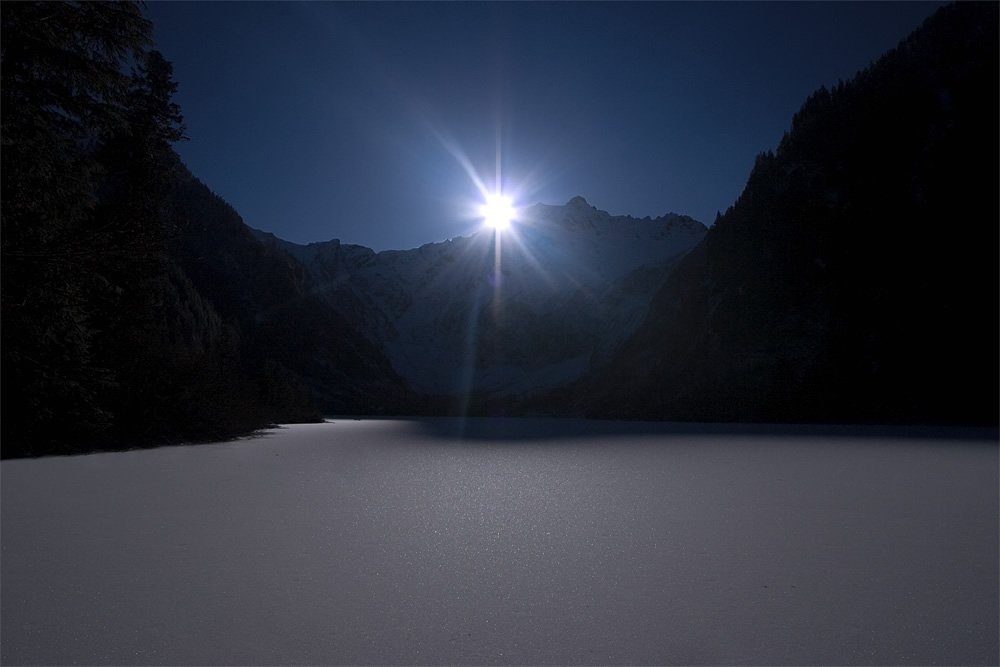
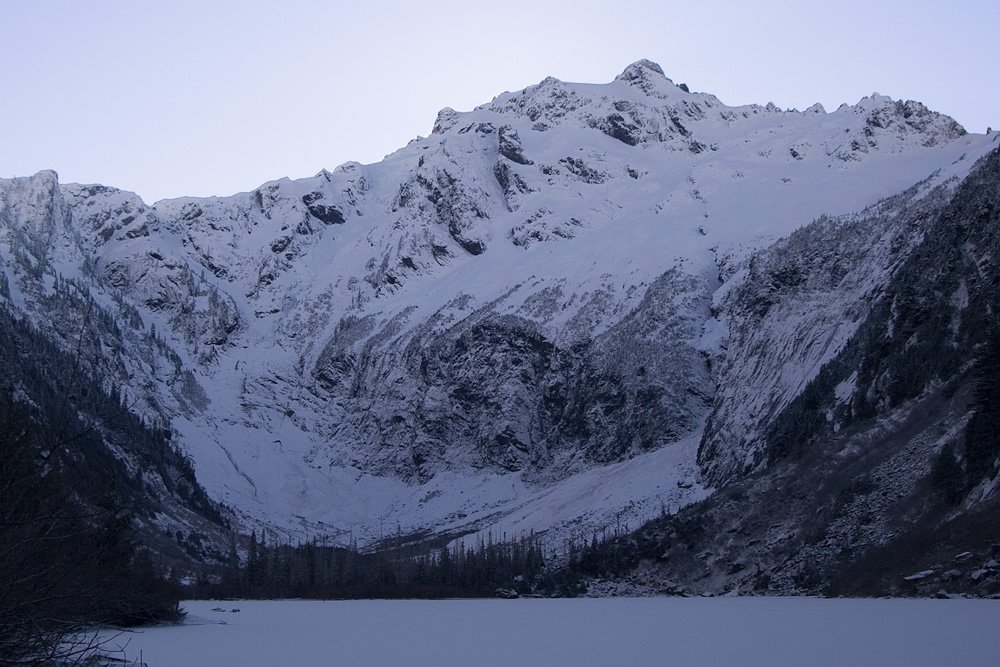
Goat Lake was completely glazed over when I finally reached it. I had just caught the last beams of sunlight disappearing behind Cadet Peak. My memory of a rippling lake bathed in warm, golden light would need to persist for at least another few seasons. I’ll add to my memory the contrasting, yet still beautiful, scene I saw today: a glittering, snowy plain, weakly lit by impending winter’s cold, blue light.
It’s about 10 miles to Goat Lake and back. The trail gains about 1300 feet, mostly at the switchbacks (or scramble) right before the lake.
Ice and snow covered much of the road beyond Barlow Pass, and it was 26 degrees at the trailhead at 8:30 AM. I started my hike shivering and bundled under several layers, hats and gloves, but after about twenty minutes, I was comfortable in just a t-shirt. The trail had a light dusting of fresh snow, and it was easy going for most of the way. I started on the Upper Trail and took the connection to the Lower Trail at the 0.8 mile mark. There were just a couple blowdowns which were easy to get around. The trail was in surprisingly remarkable shape, despite being mostly unbothered for four years and the recent storms.
The trail became hard to follow just before the lake. As I did on my first hike six years ago, I got lost and needed to scramble alongside the falls to find the lake. On my way back, I found where I took a wrong turn. But if I had stayed on the trail, I would have missed an impressive set of waterfalls. There are several US Forest Service signs marking some type of boundary in this area, but they were turned in every direction and really unclear about indicating the area I was not supposed to be in.
Goat Lake was completely glazed over when I finally reached it. I had just caught the last beams of sunlight disappearing behind Cadet Peak. My memory of a rippling lake bathed in warm, golden light would need to persist for at least another few seasons. I’ll add to my memory the contrasting, yet still beautiful, scene I saw today: a glittering, snowy plain, weakly lit by impending winter’s cold, blue light.
It’s about 10 miles to Goat Lake and back. The trail gains about 1300 feet, mostly at the switchbacks (or scramble) right before the lake.


Love the pics!
How are you cutting out the light with the long daylight exposures?
Thanks!
I had the polarizer on as an ND filter and the camera set to the lowest ISO setting (100). I think that helped. The aperture was open to f/6.3.
The shutter was firing at about 1/10 – 1/20 sec. The water was moving fast enough to get a decent blur effect.
All of these shots were hand-held. I didn’t bring a tripod and couldn’t find a good platform, so I set the camera in burst mode and just held the trigger until the buffer filled up with about 12 images, trusting at least one in each set would be stable enough to use.
Sometimes it works, most of the time it doesn’t!
John
I told you he used a polarizer, to slow the speed down. :)What polarizer are you using?Looks like a fun hike. I need to go out snow hiking sometime. Let me know if you decide to go snow shoeing this year. Wonderful shots as always.
On the wide angle lens, I have a slim B+W. I share a Hoya between the 50mm and the telephoto. Both polarizers are neutral and coated.
I’ll let you know if I plan on going snowshoeing anywhere. Thanks!
John